

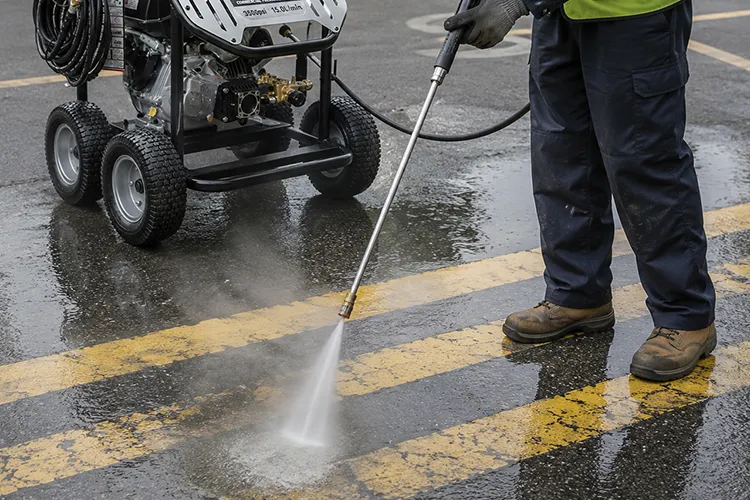
In industrial production and facility maintenance, heavy-duty pressure washers are indispensable core equipment. Unlike household cleaning machines, industrial-grade pressure washers are designed for continuous, high-intensity operations, providing higher pressure, greater flow rate, and uninterrupted operation.
What is a Heavy-Duty High-Pressure Cleaner?
A heavy duty high pressure cleaner machine is a professional cleaning device that uses a high-pressure water pump to generate a high-velocity water jet, removing stubborn contaminants from industrial equipment, building surfaces, pipelines, and more through physical impact force.
How it works: An electric motor or internal combustion engine drives a high-pressure pump → the pump generates high-pressure water → water is discharged through a nozzle at extreme velocity → the high-pressure water jet strips and flushes away dirt and grime. In industrial-grade pumps, the crankshaft converts rotary motion into linear motion of three ceramic pistons through three connecting rods—each piston retracts to draw water in and advances to compress and discharge high-pressure water.
Key Differences from Consumer Pressure Washers
| Comparison | Consumer | Heavy Duty Industrial |
|---|---|---|
| Pump type | Axial cam pump | Crankshaft (triplex plunger) pump |
| Operating pressure | Typically ≤150 bar (2200 psi) | 300 bar (4350 psi) |
| Flow rate | Typically ≤7 L/min | 15 L/min |
| Continuous operation | Intermittent use | 24/7 continuous duty |
| Pump body material | Cast aluminum | High-purity copper alloy |
| Plunger material | Stainless steel/standard | Solid ceramic plungers |
Core Features of Heavy-Duty High-Pressure Cleaners
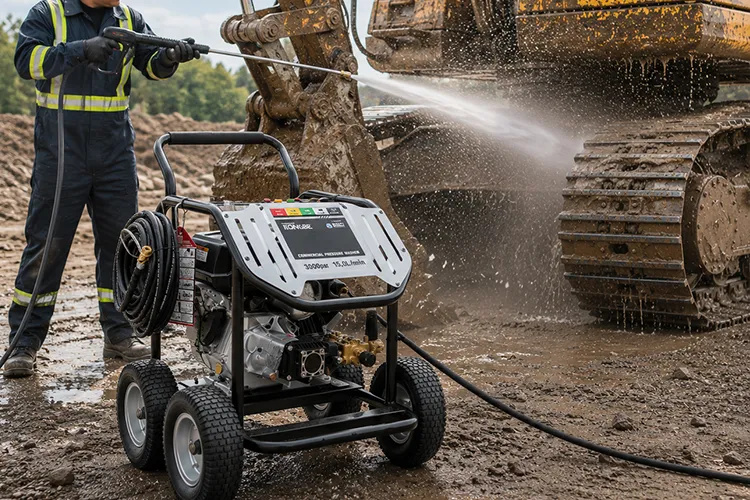
1. Industrial-Grade Pump System
The industrial-grade pump is the heart of a heavy-duty high-pressure washer. A true industrial-grade pump uses a high-purity copper alloy pump body (impurity content <0.05%) combined with a full ceramic plunger, employing a crankshaft pump structure. The ceramic plunger has high hardness, strong wear resistance, and lower operating temperature, resulting in a service life far exceeding that of ordinary stainless steel plungers. The crankshaft is precision forged and hardened to ensure strength and extend service life.
2. Powerful Power System
Industrial-grade equipment is equipped with a high-power motor (such as 15kW, 20kW, or even higher) or a gasoline/diesel engine. It features a low-speed, high-torque design, effectively reducing operating heat and vibration, ensuring the stability of the equipment under long-term continuous operation.
3. Multiple Safety Protections
Industrial high-pressure washers are typically equipped with: overload protection, undervoltage protection, overheat protection (such as 175℃ overheat protection), phase loss protection, and a dual pressure protection system with an overflow valve and a safety valve. Products from brands like Kärcher also come standard with an automatic pressure release function, protecting components and extending equipment life.
4. Robust and Durable Design
The industrial-grade body utilizes a heavy-duty aluminum alloy or epoxy-coated steel frame structure, effectively resisting water erosion and chemical corrosion. Large pneumatic tires or casters facilitate flexible movement on the job site. Some models also offer a stainless steel frame option to withstand more severe corrosive environments.
5. Intelligent Control and Convenient Maintenance
Modern industrial cleaning machines are equipped with intelligent chips that monitor the motor and pump operating status in real time. A visual pressure adjustment system allows operators to flexibly adjust pressure parameters according to different cleaning tasks.
Typical Application Scenarios of Industrial High-Pressure Cleaners
Typical Application Scenarios of Industrial High-Pressure Cleaners
Heavy-duty high-pressure cleaners are widely used in the following industries and scenarios:
Manufacturing and Heavy Industry: Removing oil, paint, and carbon deposits from machinery and production lines; deburring precision parts and cleaning sand from castings.
Petrochemical Industry: Cleaning pipeline interiors, removing coke from reactors, and removing chemical residues from storage tanks.
Shipbuilding Industry: Rust removal from ship hulls, deck cleaning, and cabin cleaning.
Construction Engineering: Cleaning of large construction machinery (excavators, cranes), cleaning of building landmarks and curtain walls, and removing concrete surfaces.
Municipal Sanitation: Cleaning of road markings, cleaning of public walls, and roughening of floor surfaces.
Power Industry: Cleaning of substation equipment and insulators.
Food Processing and Pharmaceutical Industry: Cleaning of equipment surfaces and hygienic maintenance of production lines.
Agriculture: Cleaning of livestock pens and farm machinery.
For stubborn grease and oil stains, hot water cleaners equipped with heating devices can be selected, with operating temperatures reaching 100°C, significantly improving the degreasing effect.
How to Choose a Suitable Heavy-Duty Pressure Washer?
Step 1: Define Operational Requirements
Average Daily Working Hours: Is continuous operation required 24/7?
Type of Object to be Cleaned: Oil stains, concrete residue, paint, rust, or precision components?
Site Conditions: Is there a stable three-phase power supply? Is the water supply sufficient?
Step 2: Core Parameter Matching
| Parameter | Industrial Range | Selection Advice |
|---|---|---|
| Operating pressure (bar) | 200–5300 | Precision parts: 100–150 bar; pipeline descaling: 200–300 bar |
| Flow rate (L/min) | 10–15 | Higher flow = higher cleaning efficiency; |
| Power (kW) | 4–7+ | Ensure sufficient power reserve to avoid prolonged overload |
Step 3: Pump Body Material Verification – Key Selection Criteria
✅ True Industrial Grade: High-purity copper alloy pump body + all-ceramic plunger + crankshaft pump structure
❌ Caution: Cast aluminum pump bodies are prone to cracking and leakage under continuous high-temperature conditions.
Step 4: Drive Type Selection
Electric Motor Drive: Suitable for fixed locations with a stable three-phase power supply; low operating costs and low noise.
Gasoline/Diesel Engine Drive: Suitable for field operations, environments without or with unstable power.
Kormeson’s gasoline/diesel drive series offers flexibility unrestricted by power supply, featuring a robust yet lightweight frame and large tires for easy transport and movement.
Step 5: Cold Water vs. Hot Water
Cold Water Model: Suitable for most room temperature cleaning scenarios, more energy-efficient and easier to maintain.
Hot Water Model: Equipped with a heating element (up to 100°C), highly effective against grease and oil stains.
Recommended Kormeson Industrial and Commercial High-Pressure Cleaners
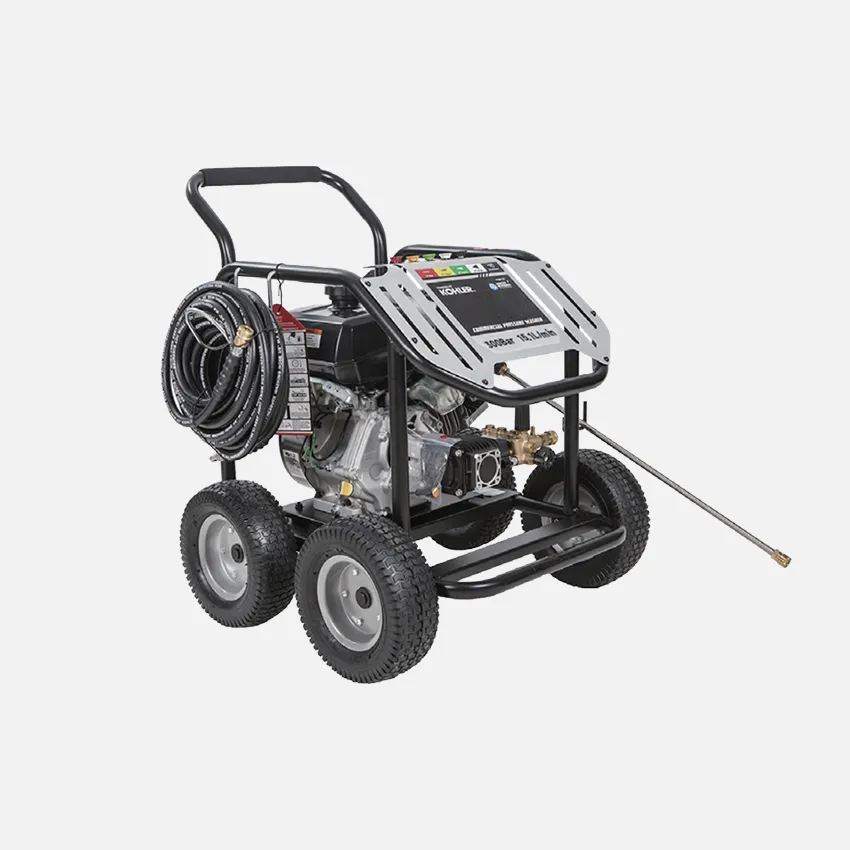
| Model | KMS-CL |
| Rated pressure | 300Bar |
| Rated flow | 15.1L/min |
| Engine | SC460(459cc) |
| Start | Recoil/E- Start |
| Pump | Triplex Pump |
| Soap tank | No(Siphon Tube) |
| Hose | 15m |
| Nozzle | 0°, 15°, 25°, 40°, Soap |
| Wheel | 12×4” |
| Net weight | 80kg |
| Dimension | 775*705*655mm |
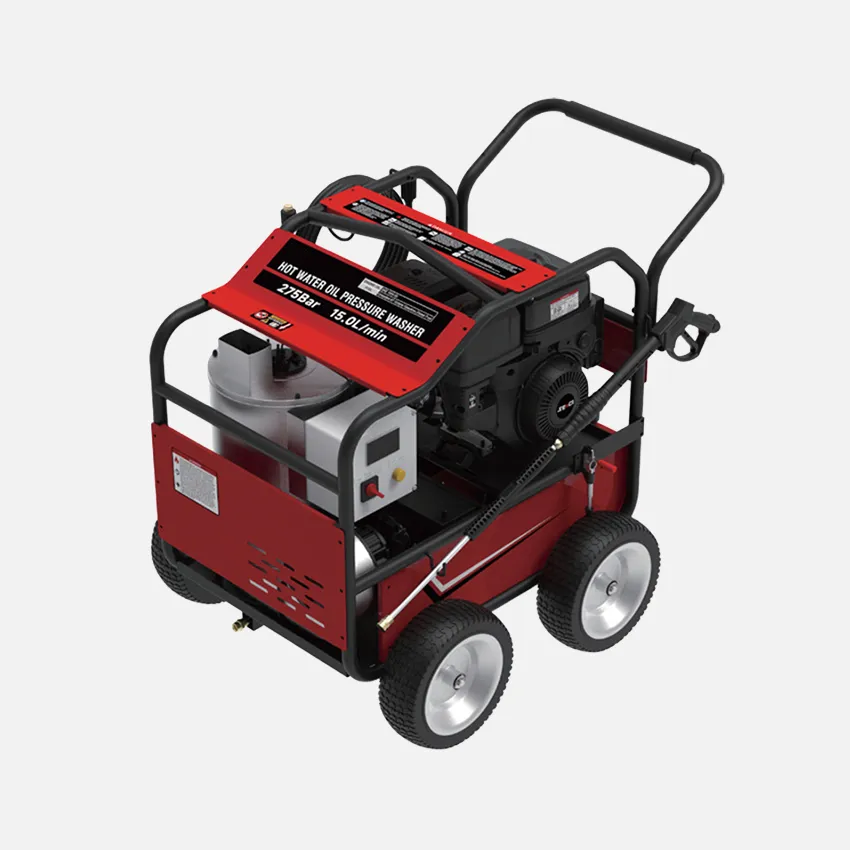
| Model | KMS-CJ |
| Rated pressure | 275Bar |
| Rated flow | 15.0L/min |
| Engine | SC460 (459cc) |
| Start | Recoil / E- Start |
| Pump | Triplex Pump |
| Engine fuel | 6L (Gasoline) |
| Fuel for heater | 20L (Diesel) |
| Water temperature | Max 100℃ |
| Hose | 15m |
| Nozzle | 0°, 15°, 25°, 40°, Soap |
| Wheel | 13×4.3” |
| Net weight | 178kg |
| Dimension | 1010*685*1030mm |
Maintenance and Troubleshooting
| Problem | Possible Causes | Troubleshooting Steps |
|---|---|---|
| Low pressure | Clogged nozzle / insufficient water supply / hose leak | Check nozzle, verify water supply, inspect hoses |
| Unit won’t start | Power issue / motor overload / protection triggered | Check power supply, reset overload protection |
| Pressure fluctuation | Unstable water intake / worn pump valves | Check water source, inspect pump valves |
Tips for Extending Equipment Life
Increase inspection and maintenance frequency during continuous heavy-duty use
Preventive maintenance is far more effective than reactive repairs in ensuring operational continuity
Store properly after use—drain residual water from pump and hoses to prevent freezing and corrosion
Frequently Asked Questions (FAQ)
Q1: If a machine is rated for 24/7 continuous operation, does that mean no maintenance is required?
A: No. 24/7 continuous duty rating means the equipment is designed to withstand prolonged operation, but regular maintenance—including filter inspection, seal replacement, and oil changes—remains essential.
Q2: How can I quickly identify a truly industrial-grade pump?
A: Check the technical specifications for pump body material: high-purity copper alloy pump body + solid ceramic plungers are the hallmarks of industrial-grade quality. Also confirm that “crankshaft pump” and “continuous duty” are specified.
Q3: Is higher pressure always better for industrial pressure washers?
A: Not necessarily. The appropriate pressure depends on the cleaning application—excessively high pressure can damage precision component surfaces or equipment coatings. Consider the match between pressure, flow rate, and the specific cleaning task.
Q4: How do I choose between cold water and hot water units?
A: If your primary cleaning tasks involve grease and oil, choose a hot water unit (operating temperatures up to 150°C). For dust, mud, and general dirt, cold water units are sufficient and more cost-effective to operate.
Heavy-duty pressure washers are indispensable cleaning tools in modern industrial production. From manufacturing to petrochemicals, from shipbuilding to municipal sanitation, industrial-grade pressure washing equipment is helping various industries complete cleaning tasks with higher efficiency and lower costs.
When selecting a model, please be sure to start from your actual working conditions and focus on key factors such as pump body material, core parameters, drive method, and total lifecycle cost, rather than simply comparing prices. A heavy-duty pressure washer that truly meets your needs will continue to create value for your production and operations for years to come.