

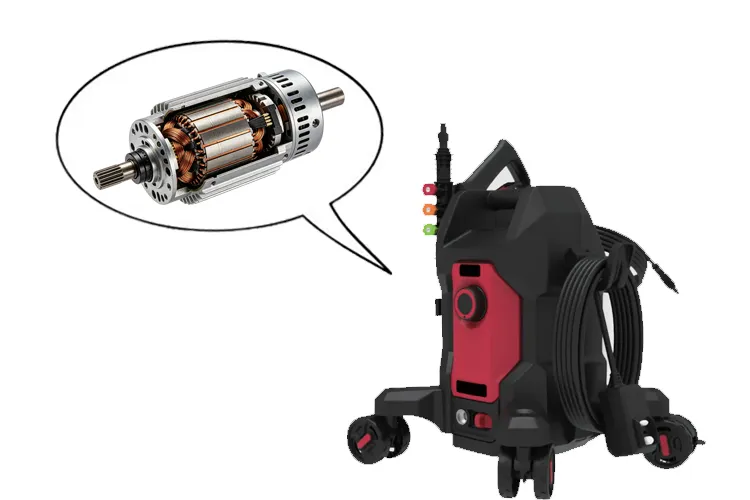
What is a Series Motor?
A series-wound motor, technically a single-phase series motor, gets its name from the series connection of its field winding and armature winding. The most significant characteristic of a series-wound motor is its dual AC/DC capability—it can use either AC or DC power, hence its international reputation as a universal motor. The motor mainly consists of three parts: the stator, rotor, and support frame. The stator comprises a salient-pole core and a field winding, while the rotor consists of a salient-pole core, armature winding, commutator, and shaft. The field winding and armature winding form a series circuit through brushes and the commutator.
Working Principle: Rotation Driven by Electromagnetic Interaction
The working principle of a series-wound motor is based on the principle of electromagnetic induction, which can be summarized by the physical law that “a current-carrying conductor experiences a force in a magnetic field.” When an external power source is applied, a magnetic field is generated within the armature winding, interacting with the magnetic field in the field winding to produce electromagnetic torque that drives the motor to rotate. As the speed increases, the back electromotive force gradually increases until it balances with the electromotive force of the external power source, at which point the motor enters a stable operating state. This characteristic, where the electromagnetic torque changes significantly with the load, is known as the “series characteristic”.
Core Advantages of Series-Wound Motors
1. High Speed and Strong Starting Torque
Series-wound motors can reach speeds of 20,000 to 50,000 rpm, far exceeding ordinary asynchronous motors (typically not exceeding 3,000 rpm). Simultaneously, their starting torque can reach 3 to 5 times the rated torque, enabling them to directly drive high loads smoothly. This characteristic allows series-wound motors to provide powerful driving force instantly upon startup, making them ideal for equipment like high-pressure washers that require rapid pressure build-up.
2. AC/DC Dual-Use, Strong Power Adaptability
Series-wound motors can be directly connected to 220V AC power or adapted to DC power without a frequency converter, greatly simplifying equipment design. For high-pressure washers, this means they can not only operate on household sockets but also be adapted to vehicle power supplies or lithium battery power, providing a technological foundation for the development of portable lithium-ion battery washers.
3. Small Size, Light Weight, and High Power Density
At the same power output, the volume of a series-wound motor is only 1/3 to 1/2 that of an asynchronous motor. This lightweight design makes pressure washers easier to carry and operate—a pressure washer equipped with a series-wound motor is significantly lighter than one with an induction motor, making it more suitable for home users who need to move frequently or have limited storage space.
4. Wide Speed Range and Easy Control
Series-wound motors can achieve speed ratios of 10:1 or higher by adjusting the voltage, eliminating the need for complex control circuits. Pressure washer manufacturers often utilize this feature to design multi-level pressure adjustment functions—for example, the Kärcher K3 Plus HR model uses a series-wound motor, achieving two adjustable pressure levels, high and low, with a maximum peak pressure of 120 bar.
5. Low Cost and High Cost-Effectiveness
The manufacturing process for series-wound motors is mature, and the core components are highly standardized, resulting in manufacturing costs far lower than induction motors. This means that pressure washers equipped with series-wound motors are usually cheaper than their counterparts with induction motors, often by hundreds or even thousands of yuan, making them an ideal choice for home users and beginners.
6. Series Motors Operate at Extremely High Speeds
These features make them suitable for:
*Car washing
* Patio cleaning
* Outdoor furniture cleaning
* Bicycle cleaning
*Garden equipment cleaning
Inherent Shortcomings of Series-Wound Motors
1. Limited Brush Life, Requires Regular Maintenance
Series-wound motors use carbon brushes and a commutator. Carbon brushes are consumable parts with a typical lifespan of 500 to 1000 hours. With increased use, brush wear leads to increased sparking, decreased speed, and even affects motor performance. This has little impact on occasional home use of high-pressure washers, but in high-frequency use environments, regular inspection and replacement of carbon brushes are necessary.
2. Higher Noise Levels
At high speeds, the noise generated by brush friction and commutator switching in series-wound motors can reach 75 to 85 dB. In contrast, induction motors typically operate at less than 80 dB, exhibiting superior noise control. In residential areas or quiet environments, the noise from series-wound motor washers may cause discomfort.
3. Lower Energy Efficiency
Brush contact resistance, commutation losses, and eddy current losses result in an efficiency of approximately 70% to 85% for series-wound motors, lower than that of brushless DC motors (85% to 95%). This means that, for the same output power, series-wound motors consume slightly more power.
4. Electromagnetic Interference Issues
The sparks generated when the commutator contacts the brushes release electromagnetic radiation, which may affect the normal operation of surrounding electronic equipment. High-end series-wound motors are equipped with additional RC filter circuits to suppress electromagnetic interference, but for cost-sensitive low-end products, users may need to pay attention to the distance between the motor and sensitive electronic equipment.
Series motors remain one of the most popular motor choices for electric pressure washers. Their lightweight construction, affordable price, high-speed performance, and compact size make them ideal for home cleaning applications. If your primary cleaning tasks involve cleaning vehicles, patios, outdoor furniture, bicycles, and household surfaces, a series motor pressure washer will offer excellent value and reliable cleaning performance. However, if you require longer runtime, lower noise levels, and maximum durability, an induction motor pressure washer may be a better long-term investment.