

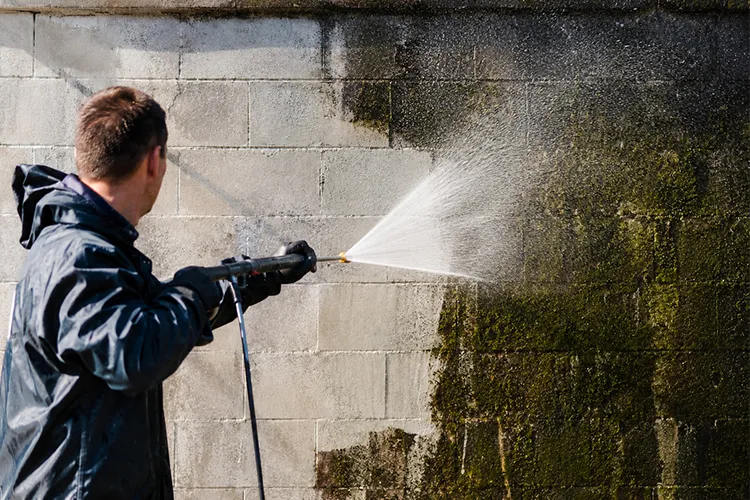
Many homeowners believe that exterior walls, roofs, driveways, or yards don’t need cleaning unless there’s obvious damage. In fact, long-term accumulation of dirt, mold, algae, dust, and pollutants not only affects aesthetics but also shortens the lifespan of building materials and increases maintenance costs. Regular home cleaning is not just for aesthetics; it’s about protecting the building structure, extending the lifespan of materials, improving occupant health, and maintaining property value. Regularly using a pressure washer or soft washing to clean exterior walls, roofs, driveways, yards, and fences effectively removes dirt, mold, and algae, avoiding hefty repair costs and keeping your home in optimal condition.
What Are the Benefits of Cleaning Your Home?
Regular (recommended every 1-2 years) home cleaning with a pressure washer isn’t just for aesthetics; it offers the following practical benefits:
✅ 1. Improved Home Appearance and Resale Value
Clean exterior walls, driveways, and fences instantly enhance curb appeal. For those planning to sell or rent, pressure cleaning is the most cost-effective renovation method.
✅ 2. Prevention of Long-Term Damage from Mold and Algae
Black mold and green algae secrete acidic substances that gradually penetrate paint films or cement pores, causing peeling and powdering. Cleaning removes these sources of corrosion.
✅ 3. Reduced Allergens and Bacterial Growth
Organic grime accumulated on exterior walls, eaves, and gutters is a breeding ground for mold spores. Cleaning significantly reduces the risk of respiratory allergies in family members.
✅ 4. Provides a Clean Base for Repainting or Repairs
If you plan to paint your house, you must thoroughly clean the walls first. Otherwise, paint adhesion will be poor, and the paint will peel within months.
✅ 5. Extend the Lifespan of Fences, Patios, and Driveways
Wooden fences will rot faster if not washed; oil stains on cement floors will accelerate weathering. Regular cleaning can postpone replacement costs.
✅ 6. Reduce Pests
Spiders, ants, and cockroaches like to hide in layers of dirt and crevices in walls. Exposing these crevices after cleaning makes it easier to seal them and prevent pests from entering.
High-Pressure Cleaning VS Soft Cleaning
| Scenery | Recommended Methods | Reasons |
| Cement driveway, brick wall | High-pressure cleaning | Hard surface, impact resistant; high pressure can remove stubborn stains. |
| Asphalt shingle roof | Soft wash | Roofing particles are prone to detachment. |
| Old wooden exterior wall | Soft wash | Prevents water pressure from corroding the wood. |
| Vinyl | Low-pressure cleaning (800–1500 PSI) | Medium pressure is sufficient; excessive pressure will allow water to seep into the gaps between the boards. |
| Stone, stucco wall | Soft wash | Prevents surface peeling. |
📌 Soft wash core: cleaning solution + extremely low pressure (<500 PSI) + soaking time. Can be directly simulated using the low-pressure mode of a high-pressure washer.
The KMS H series electric high-pressure washers are suitable for various home use scenarios. The table shows the three most popular models, and you can choose the corresponding model according to your usage habits.
| Model | PSI | GPM | Wheel | Hose Reel | Application Scenarios |
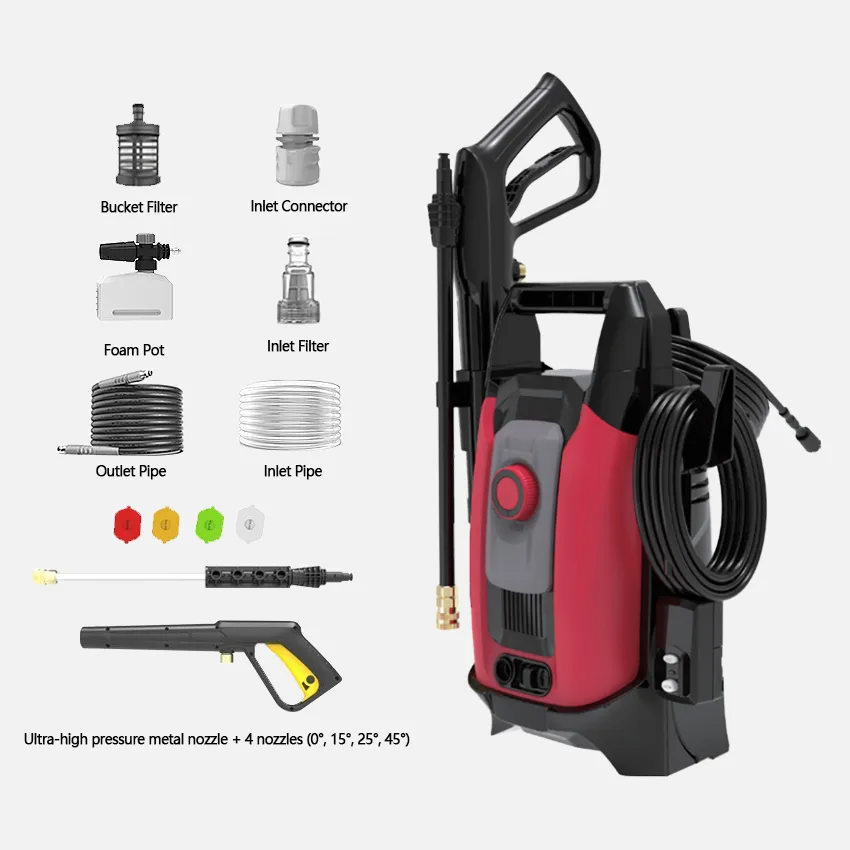 KMS-H01 | 1300~2200 | 1.37~1.45 | ❌ | ❌ | ★ Courtyard cleaning |
| ★ Floor cleaning | |||||
| ★ Farm cleaning | |||||
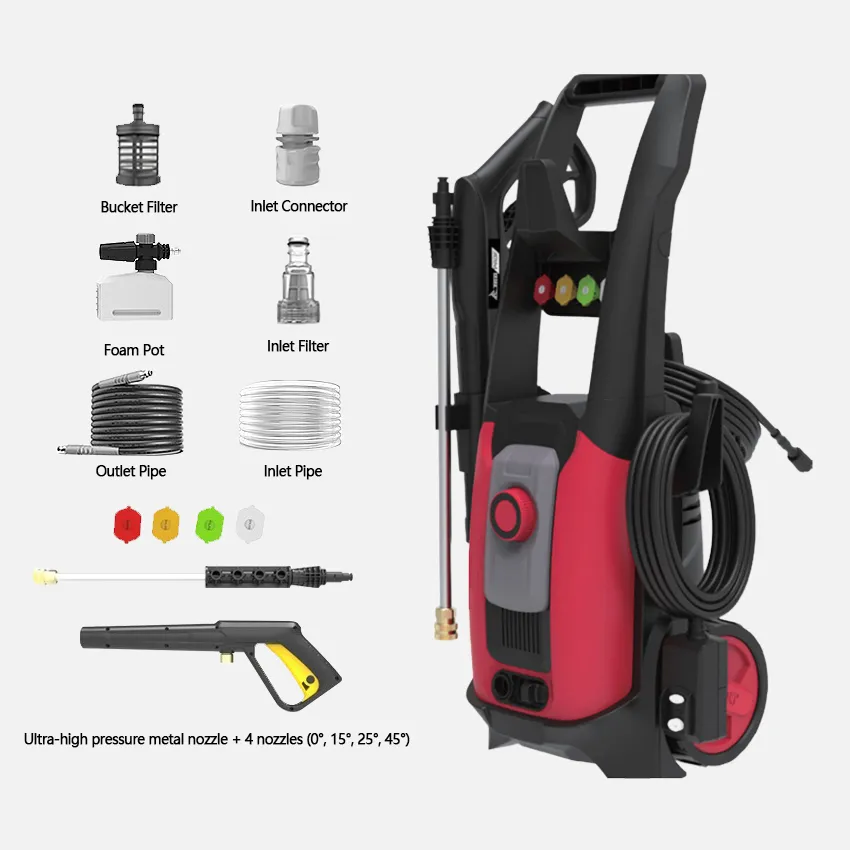 KMS-H02 | ✅ | ❌ | ★ Car washing | ||
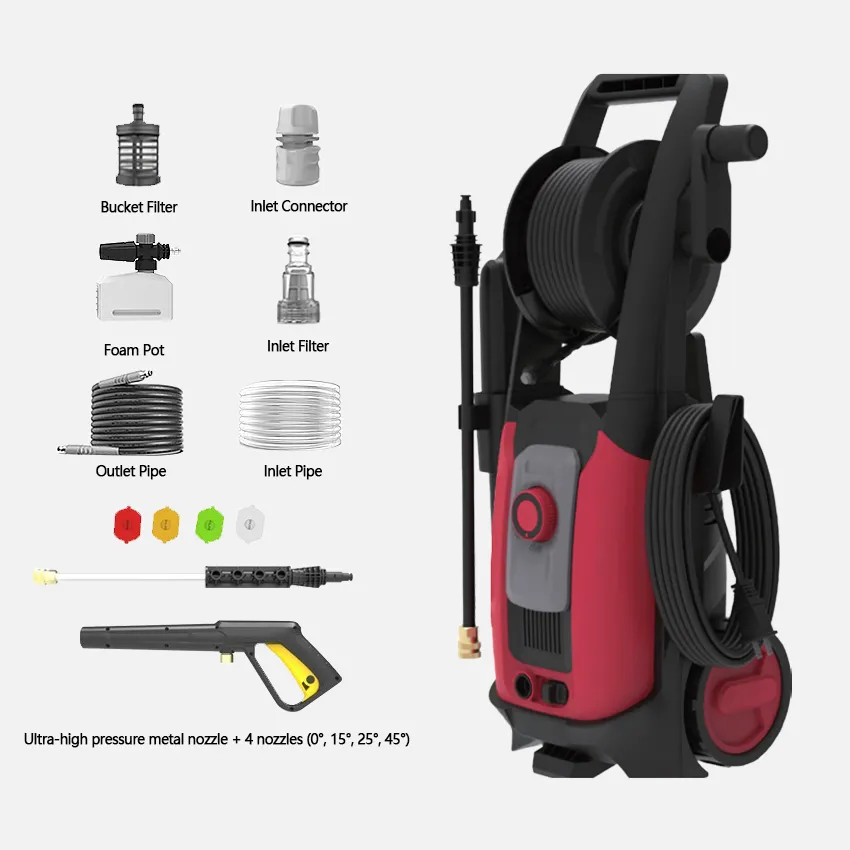 KMS-H03 | ✅ | ✅ | ★ Property outdoor cleaning |
Next, we will tell you how to properly use a cleaning machine to clean a house.
Preparations Before Cleaning
Before officially starting the machine, please complete the following preparations, as they affect the cleaning effect and safety.
✅ Equipment Selection
Recommended pressure range for home use: 1300–2200 PSI (pounds per square inch). Excessive pressure can damage wooden or brick walls, while insufficient pressure will make it difficult to remove stubborn stains.
Type: Electric pressure washer (lightweight, low noise) suitable for most building exteriors; fuel-powered models offer higher pressure and are suitable for large concrete floors.
✅ Necessary Accessories
Nozzles: Prepare at least four angles: 0°, 15°, 25°, and 40°. 0° is a powerful straight line, and 40° is a low-pressure wide fan.
Floor Cleaning Pad: Very easy to use for cleaning driveways and patios.
Extension Pole: Used when cleaning second-floor eaves to avoid climbing.
✅ Personal Safety Equipment
Non-slip shoes, safety goggles, rubber gloves. High-pressure water guns have significant recoil; never operate while wearing slippers.
✅ House and Environment Inspection
Inspect walls: Check for cracks, peeling paint, or loose mortar. If found, repair before cleaning; otherwise, high-pressure water will worsen the damage.
Close all windows and cover outdoor sockets, light fixtures, and air conditioner units with plastic sheeting.
Move outdoor furniture and flower pots, and cover nearby plants (using old sheets or waterproof tarpaulins).
Remind family members and pets to stay away from the work area.
Detailed Steps for Cleaning a House with a High-Pressure Washer
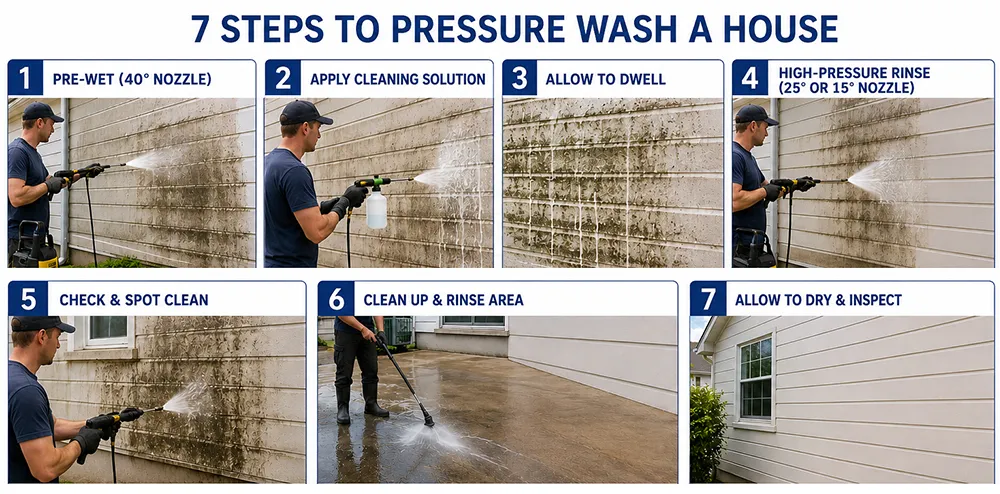
Follow these 7 steps to ensure a thorough cleaning without damaging your walls.
Step 1: Low-Pressure Pre-wetting (40° Nozzle)
Attach the 40° nozzle and hold it about 40 cm away from the wall. Evenly wet the wall from top to bottom. This step reduces the drying time of the cleaning agent and softens loose dust.
Step 2: Apply Cleaning Agent
Using the low-pressure suction mode on your high-pressure washer (or a separate hand-operated spray bottle), evenly spray the specialized exterior wall cleaner onto the soiled areas. Do not use bleach or acidic cleaners, as they will corrode cement and bleach paint.
Step 3: Wait for the Reaction
Wait 3–5 minutes for the cleaning agent to break down mold and grease. Avoid letting the cleaning agent completely dry on the wall (work in sections when in strong sunlight).
Step 4: High-Pressure Rinsing (25° or 15° Nozzle)
Sweep from top to bottom and left to right, overlapping each stroke by 1/3.
Maintain distance: Test at a distance of 30 cm from the wall first. If the stain is not removed, gradually move closer to 15 cm.
Avoid vertical spraying, especially on crevices, window frames, and brick joints, otherwise water will seep into the wall.
Step 5: Inspect Stubborn Stains
For residual black mold or oil stains, use a 15° nozzle for spot cleaning. If the stain is still not removed, repeat the cleaning solution application.
Step 6: Clean the Floor and Equipment
Rinse the floor for any remaining cleaning solution (pay attention to the drainage direction to avoid it flowing into the rainwater drain). Unplug the power/turn off the fuel, drain the high-pressure water hose and water from the spray gun, disassemble the nozzle and dry it before storing.
Step 7: Allow to Air Dry
Wait 24 hours, then check the wall for signs of moisture seepage (such as dampness inside the window sill). If necessary, address any issues beforehand.
Washable Areas (✅)
High-pressure washers are suitable for the following hard surfaces (appropriate pressure and nozzle are required):
| Areas | Recommended Nozzle | Stress Recommendations |
| Cement/concrete exterior walls, driveways | 15°–25° | Medium-High |
| Brick walls (non-powdered) | 25° | Medium |
| Wooden fences, patios (treated wood) | 40°(low pressure) | Low |
| Vinyl (PVC) siding exterior wall panels | 25°–40° | Low-Medium |
| Eaves, gutters (interior) | 40° | Low |
| Outdoor metal/plastic furniture | 40° | Low |
| Paving bricks, stone flooring | 25° | Medium |
✅ Tip: When cleaning wooden surfaces, the nozzle should be moved along the grain of the wood to avoid leaving horizontal scratches.
Areas Prohibited or Subject to Caution When Cleaning (❌ – Very Important)
The following areas must never be cleaned with a pressure washer, as this could cause serious damage or safety hazards.
❌ Roofs: Especially asphalt shingles, solar panels, and clay tiles. High-pressure water will wash away the surface particles, causing leaks.
❌ Window seals and door seals: Water pressure will directly penetrate the sealant, causing seepage.
❌ Meter boxes, air conditioner outdoor unit fins, and exhaust vents: May cause short circuits or mechanical damage.
❌ Loose paint or old wood: High-pressure water will scrape off paint and wood fibers like a “blade.”
❌ Any decorative materials marked “low pressure”: Such as artificial cultured stone, stucco walls, and plaster finishes.
❌ Power outlets and outdoor lights: Even with rain covers, direct sunlight should be avoided.
⚠️ Plants and flowers: Even without direct spraying, the mist carrying the cleaning solution can scorch leaves; always cover them.
📌 For roofs or old exterior walls, it is recommended to use a low-pressure soft washing method, which involves spraying with a special chemical solution and then gently rinsing with a water flow of less than 500 PSI.
Precautions for Cleaning (Safety and Effectiveness)
Higher pressure is not always better: Spraying cement at close range with pressure exceeding 2500 PSI may cause dents; it can be devastating to wooden exterior walls.
Start from the furthest point: Begin cleaning from the highest or dirtiest area of the house to avoid secondary contamination of the cleaned area.
Maintain a safe distance: Test in an inconspicuous corner before changing nozzles or wall materials.
Do not operate from ladders: The recoil of the high-pressure water gun can easily cause ladders to tip over; use an extension pole to operate from the ground.
Never use wire brushes or mix with bleach: Bleach + some cleaning agents will produce chlorine gas, which can corrode metal parts.
Beware of slippery surfaces: Driveways and patios will be very slippery after cleaning; set up warning signs.
Children and pets: Cleaning must be done indoors or at a distance; the high-pressure water jet can cut skin.
Common Misconceptions and Frequently Asked Questions (FAQs)
Q1: Can I use a pressure washer to clean my roof?
A: Not recommended. If cleaning is necessary, hire a professional soft cleaning company using low-pressure specialized equipment.
Q2: How often should I clean my house?
A: Generally once every 1-2 years. In humid coastal areas or densely wooded areas, once a year is sufficient; in dry areas, it can be extended to 3 years.
Q3: Is it necessary to use cleaning agents?
A: Not necessarily. For light dust, water is sufficient. However, black mold, algae, and grease must be cleaned with a cleaning solution to be effective.
Q4: Can I directly wash the heat exchange fins of an air conditioner outdoor unit?
A: Absolutely not! The heat exchange fins are very soft, and high-pressure water will flatten them, leading to poor heat dissipation. If cleaning is necessary, disconnect the power and gently clean with a soft brush.
Q5: Should I clean it myself or hire someone?
A: DIY is possible for single-story houses (two stories or less) or simple exterior walls. For high-rise buildings, older houses, and complex roofs, it is recommended to hire a professional pressure cleaning company.
Q6: Will water enter the house during cleaning?
A: Water can get in if windows are not closed, electrical outlets are not sealed, or the water is exposed to direct sunlight on the window frame for a long time. Be sure to take precautions in advance.