

A miter saw is a power tool designed for precise cross-cutting, miter cutting, and bevel cutting. It typically features a circular saw blade mounted on a pivoting arm; by adjusting the angle between the blade and the workpiece, it enables controlled cuts at various angles.
Compared to handheld circular saws, electric miter saws offer greater control over the cutting path and are better suited for repetitive tasks that demand high precision and specific angles.
Depending on the model, miter saws can perform straight cross-cuts, miter cuts, bevel cuts, and compound cuts.
How Do You Choose a Miter Saw?
The right approach is to first determine the material to be cut, workpiece dimensions, required angles, and frequency of use, and then match these against the saw type, blade size, motor power, RPM, cutting capacity, safety features, dust collection system, and your budget. The best miter saw isn’t necessarily the one with the highest specifications, but the one that best aligns with your actual work requirements.
In short: Material + Blade Size + Motor Power + Cutting Capacity + Cutting Angles + RPM + Usage Scenario + Safety = The Right Miter Saw.
A miter saw directly impacts cutting precision, workflow efficiency, safety, and overall productivity. Whether you are a DIY enthusiast, woodworker, professional carpenter, construction contractor, furniture manufacturer, or bulk purchaser, you should look beyond just price and motor power.
7 Things to Consider When Choosing a Electric Miter Saw
Step 1: Clarify the Intended Use Scenario
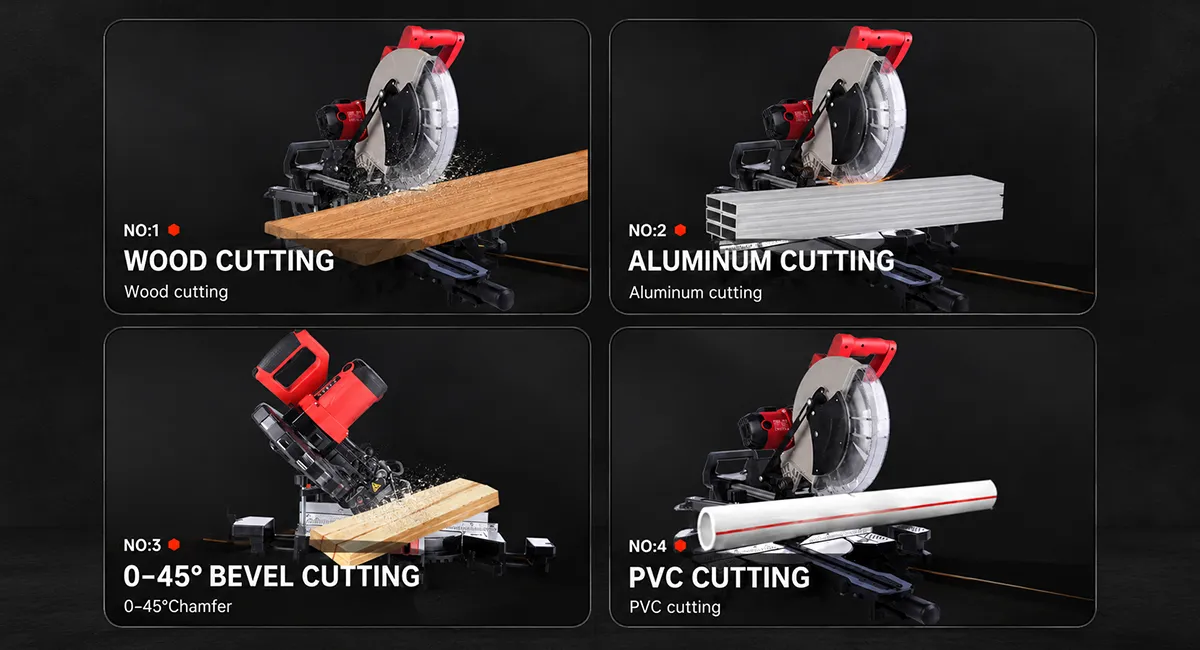
When choosing a corded electric miter saw, the first step is to clarify your actual cutting requirements.
| Key Questions | Impact | Choosing the Right Type |
| What material needs to be cut? | Determines motor, blade, and RPM requirements | Different saw blades and configurations are required for wood, aluminum, and PVC. |
| What are the dimensions of the item to be cut? | Determines cutting width, depth, and blade size | Sliding models are preferable for wide boards. |
| What cutting angle is required? | Determines single-bevel, dual-bevel, or compound-bevel capabilities | Double-bevel models are best for complex angles. |
| What is the frequency of use? | Determines durability, stability, and dust collection requirements | For professional, high-frequency use, prioritize continuous operation capability. |
Step 2: Types of Miter Saws
| Type | Key Features | Suitable Applications | Notes |
| Compound Miter Saw | Simultaneous miter and bevel cutting | Carpentry, decorative molding, furniture, framing, general construction | Offers greater angle flexibility than standard miter saws, but lacks a sliding rail mechanism. |
| Single Bevel Miter Saw | Bevels in one direction only | General carpentry, door frames, window frames, flooring | Features a simple design; suitable for tasks that do not require dual-bevel capability. |
| Dual Bevel Miter Saw | Bevels in both directions | Professional carpentry, furniture manufacturing, decorative molding, high-volume repetitive processing | Reduces the need to flip or reposition the workpiece. |
| Sliding Compound Miter Saw | Combines compound cutting with a sliding mechanism | Wide boards, large decorative molding, flooring, construction materials | Can increase effective cutting width; focus on the maximum cutting width specification. |
Step 3: Saw Blade Size
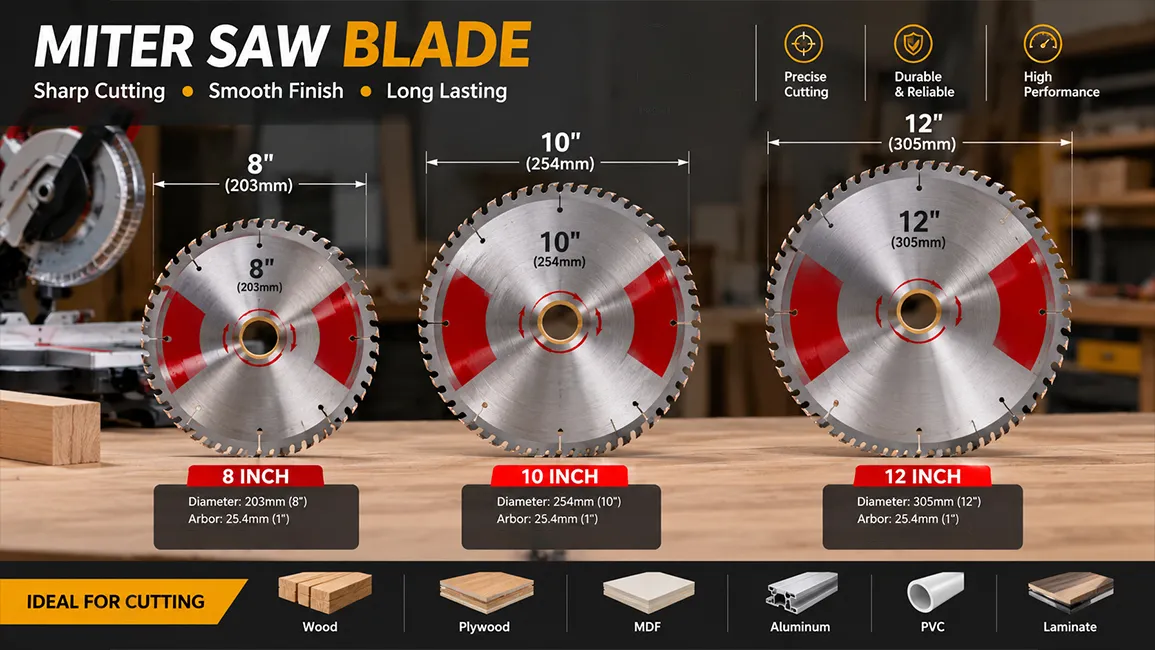
Common miter saw blade sizes include 8 inches, 10 inches, and 12 inches.
The larger the blade, the greater the cutting capacity. Your actual choice should take into account workpiece dimensions, cutting depth, portability, motor specifications, and the intended use scenario.
| Saw Blade Size | Features | Suitable Applications |
| 8-inch | Compact and portable | DIY, small-scale woodworking, decorative molding, mobile operations |
| 10-inch | Balances cutting capability, portability, and versatility | General carpentry, construction, furniture projects, home renovation |
| 12-inch | Higher cutting capability | Professional carpentry, large-scale decorative molding, thicker timber, heavy-duty processing |
Step 4: Motor Power and RPM
Motor power affects the miter saw’s ability to maintain cutting performance under load. Higher power is better suited for harder materials, thicker or larger workpieces, high-frequency cutting, and professional applications.
RPM indicates the number of blade rotations per minute. Under the right conditions, higher RPM can help achieve faster cuts; generally, smaller blades operate at higher speeds.
Step 5: Evaluating Cutting Capacity
Cutting capacity refers to the maximum material dimensions a miter saw can cut under specific operating conditions. This is a crucial parameter when purchasing a saw; even with a high-power motor, the machine cannot meet practical needs if it cannot accommodate the workpiece.
Cutting capacity specifications may include: maximum cross-cut width, maximum cutting depth, maximum miter capacity, maximum bevel capacity, and cutting capacities at various angles.
When selecting a compound miter saw, pay special attention to cutting capacities at specific angles, as the actual cutting capacity can change when the blade is tilted or rotated.
How to choose the cutting width?
Cutting width is particularly important if you frequently cut wide boards. Key factors to consider include: blade diameter, rail design, fence design, and maximum cross-cut width.
Sliding miter saws generally offer greater cutting width.
How to choose the cutting depth?
Cutting depth determines the maximum thickness of material the machine can cut in a given configuration. When selecting a model, check the maximum cutting depth and verify whether that figure applies to straight cuts or cuts made at specific angles.
Step 6: Bevel Angles and Tilt
The ability to make angled cuts is a key reason why many users choose a miter saw over a standard circular saw.
A 0–45° bevel angle means the saw blade can be adjusted from a standard 0° vertical position to a 45° tilt in a specific direction. 45° bevel cuts are commonly used for molding, picture frames, furniture components, angled joints, and construction work; it is important to check the product specifications to see if the 45° capability applies to a single direction or both directions.
The fundamental difference between single-bevel and dual-bevel saws lies in the direction of the blade tilt: a single-bevel saw tilts in only one direction, whereas a dual-bevel saw can tilt in both directions.
For simple projects: A single-bevel saw may be sufficient.
For repetitive tasks or complex compound angle cuts: A dual-bevel saw can reduce the need to reposition the workpiece.
Step 7: Selecting Additional Features
Once the basic specifications meet your requirements, additional features can enhance the user experience, precision, safety, and operational efficiency.
Laser or LED Cut-Line Indicator
Helps identify the intended cut line; ideal for workpiece positioning, repetitive cuts, installing decorative trim, and improving efficiency.
Base Stability and Structure
A stable base helps maintain the position of both the machine and the workpiece during cutting. Key aspects to consider include base rigidity, fence design, workpiece support, vibration dampening, and overall structural integrity.
Dust Collection System
In woodworking applications, miter saws generate significant amounts of sawdust. Dust collection systems may include dust bags, dust ports, and connections for shop vacuums. Effective dust collection helps keep the workspace tidy while improving visibility in the cutting area and protecting the operator’s health.
Safety Features
Safety should always be a top priority. Common safety features include blade guards, safety switches, trigger designs, motor brakes, and stable workpiece support. Additionally, it is essential to follow operating instructions and use appropriate personal protective equipment (PPE).
Key Information for Basic Miter Saw Selection
| Application Scenarios | Recommended Types | Key Specifications |
| DIY Projects | Compact/Standard Miter Saw | Portability, ease of use |
| General Woodworking | Compound Miter Saw | Precision, versatility |
| Wide Boards | Sliding Miter Saw | Cutting width |
| Professional Woodworking | Dual-Bevel Miter Saw | Angular flexibility, stability |
| Heavy-Duty Applications | High-Power Miter Saw | Motor power, durability |
| Multi-Material Cutting | Suitable for Multi-Material Cutting | Saw blade compatibility |
| Furniture Making | Stable, Precise, and Highly Repeatable Models | Precision, motor durability, angular repeatability |
| Construction and Carpentry | Portable, Versatile Models | Weight, cutting capacity, durability, ease of transport |
| Factory and Industrial Applications | Heavy-Duty/Continuous-Use Equipment | Durability, precision, productivity, maintenance and spare parts |
When choosing a miter saw, do not focus solely on power or blindly opt for the largest blade. High power does not guarantee superior performance, and a larger blade does not necessarily mean the right cutting capacity; it may simply add weight and take up more space. Instead, evaluate the machine based on your actual needs, considering factors such as power, blade size, RPM, maximum cutting width and depth, and cutting capabilities at various angles.
Also, do not overlook blade quality, price, safety features, and dust collection. Select the blade based on the material, thickness, and required finish. Safety and dust collection significantly impact the user experience and the working environment. The best machine is not the one with the highest specifications, but the one that best aligns with your specific requirements.