

With increasingly more outdoor space in homes, home electric pressure washer has become a powerful tool for modern home cleaning. Whether in the yard, garage, road, or outdoor facilities, the pressure washer uses a motor-driven pump to convert ordinary tap water into a high-speed, high-pressure water stream, quickly removing various surface contaminants.
• Dust and Mud
• Oil stains and Tire marks
• Moss, Algae, and Mold
• Industrial dirt
However, different road surfaces have significantly different tolerances to water pressure. Excessive pressure can damage asphalt surfaces, crack natural stone, loosen brick joints, or damage wood fibers. Therefore, before use, you need to appropriately select the working pressure (PSI/Bar), nozzle type, cleaning distance, and cleaning agent type based on the road surface material.
We will provide you with a systematic analysis of:
1. Which road surfaces are suitable for a household electric high-pressure washer?
2. Recommended cleaning pressure for various road surfaces
3. Common stain types and methods for treating stubborn stains
4. Standardized operating procedures and equipment selection recommendations
What types of surfaces can a household electric high-pressure washer clean?
Household electric high-pressure washers are suitable for various outdoor surfaces in residential and light commercial environments, including:
| Road Surface Type | Recommended Application Scenarios |
| Concrete Surface | Garages, parking lots, courtyard paths |
| Asphalt Surface | Private roads, parking areas |
| Brick Pavement | Gardens, sidewalks |
| Natural Stone | Courtyard paving |
| Wood Deck | Outdoor platforms, terraces |
| Concrete Wall | Exterior wall cleaning |
Recommended Cleaning Solutions and Pressures for Different Road Surfaces
Concrete Surface Cleaning
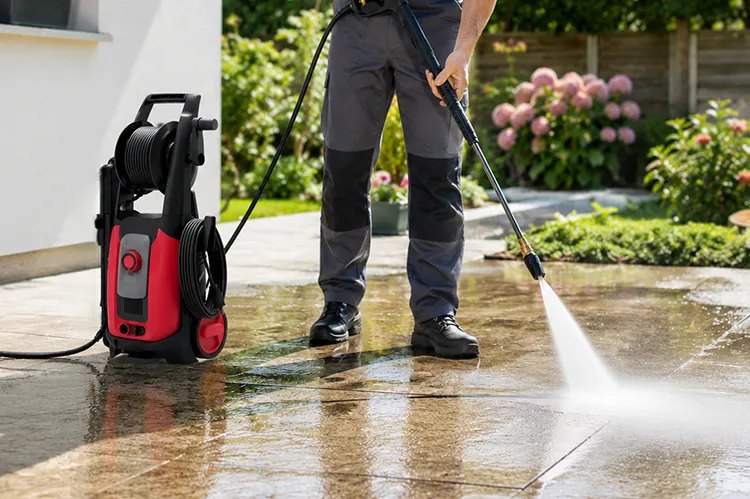
Features: High hardness, wear resistance, high water absorption, and micropores on the surface, easily adsorbing dust, oil, moss, etc.
Common Applications:
• Garage Driveway: Oil leaks, tire scuff marks, mud and sand
• Concrete Patio: Black stains caused by dust, algae, and rainwater
• Parking Area: Engine oil, fuel residue, and mud from vehicles
Recommended cleaning pressure:
| Cleaning Targets | Recommended Pressure |
| Daily dust | 1500-2000 PSI (approx. 103-138 Bar) |
| Dirty stains | 2000-2500 PSI (approx. 138-172 Bar) |
| Oil stains | 2500-3000 PSI (approx. 172-207 Bar) |
| Old and stubborn stains | Above 3000 PSI (approx. 207 Bar) |
Cleaning Steps:
1. Remove surface debris—Remove stones, leaves, and trash, avoiding splashing debris with high-speed water jets.
2. Spray cleaning agent—For oil stains and black stains, use concrete cleaner or degreaser, and wait 5-15 minutes for dissolution.
3. Select the appropriate nozzle—A 15° nozzle is for heavy stains, 25° for concrete floors, and 40° for daily cleaning. Avoid prolonged use of a 0° nozzle to prevent surface peeling.
4. Maintain the correct distance—Hold the spray gun 30-50cm above the ground and move it at a steady speed, avoiding stopping in one spot.
Asphalt Surface Cleaning
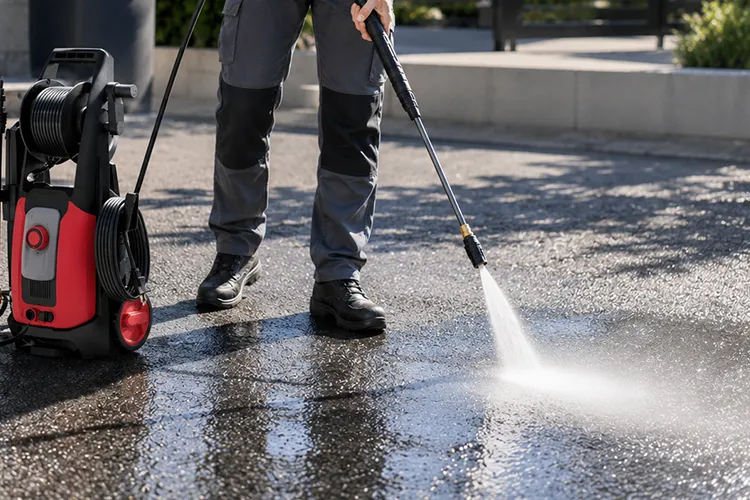
Characteristics: Asphalt pavement is softer than concrete, primarily composed of aggregate and asphalt binder, and has lower compressive strength. Excessive pressure can lead to particle shedding, potholes, or accelerated aging.
Common Contaminants: Dust, mud, oil, tire tracks, moss.
Recommended cleaning pressure:
| Cleaning Objectives | Pressure Range |
| Daily Cleaning | 1000-1500 PSI |
| Dirty Removal | 1500-2000 PSI |
| Oil Stain Removal | Approx 2000 PSI |
Cleaning Method
1. Wet the surface with a low-pressure water stream
2. Spray cleaning agent
3. Rinse using a 25° or 40° nozzle
4. Check for loose surfaces or detached particles
Brick Pavement Cleaning
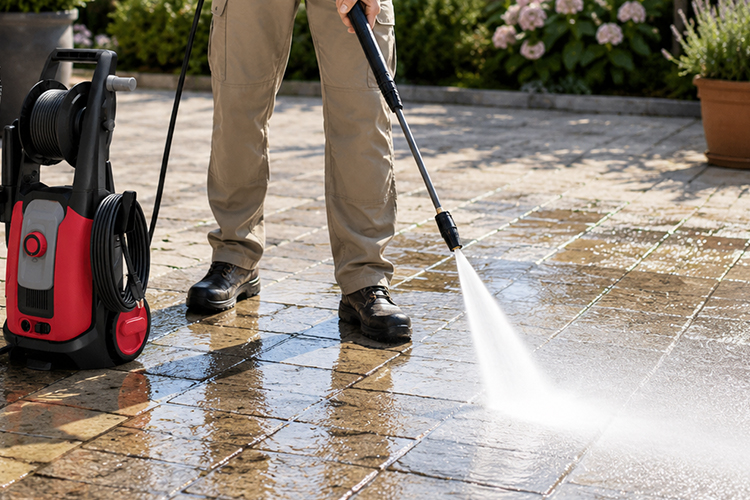
Features: Gaps, sand layers, and tiny pores exist between the bricks, easily accumulating soil, leaf mold, moss, algae, and black mold. Pressure must be controlled to avoid dislodging the grout or loosening the bricks.
Recommended cleaning pressure:
| Cleaning Targets | Recommended Pressure |
| General dust | 800-1200 PSI (approx. 55-83 Bar) |
| Soil contamination | 1200-1800 PSI (approx. 83-124 Bar) |
| Moss removal | 1500-2000 PSI (approx. 103-138 Bar) |
| Oil stains | Below 2000 PSI |
Cleaning Steps:
1. Remove leaves, small stones, and other debris from the surface.
2. Fully wet the brick surface with a low-pressure water flow to soften the soil.
3. Treat the moss with an algaecide or anti-mold cleaner, and wait 10-15 minutes.
4. Use a 25° or 40° nozzle, maintaining a distance of 30-50cm, and rinse along the brick joints.
5. Replenish grout – Some grout may be lost during cleaning; it is recommended to refill with quartz sand or polymer sand.
Natural Stone Surface Cleaning
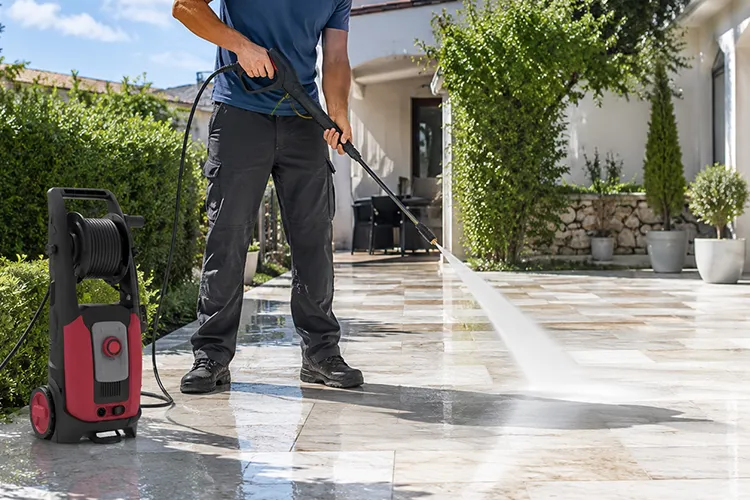
Common types: Granite, Marble, Bluestone, Sandstone, Limestone
Recommended cleaning pressure:
| Stone Types | Recommended Pressure |
| Granite | 1500-2000 PSI |
| Bluestone | 1200-1800 PSI |
| Marble | 800-1200 PSI |
| Sandstone | 800-1200 PSI |
Cleaning Method:
1. Test pressure in an inconspicuous area and observe for discoloration, scratches, or powdering.
2. Use a pH-neutral cleaner; avoid using strong acidic cleaners that may corrode the surface.
3. Keep the spray gun at a distance of 40-60cm and use low pressure to rinse, avoiding direct impact on the stone texture.
Wood Deck Cleaning
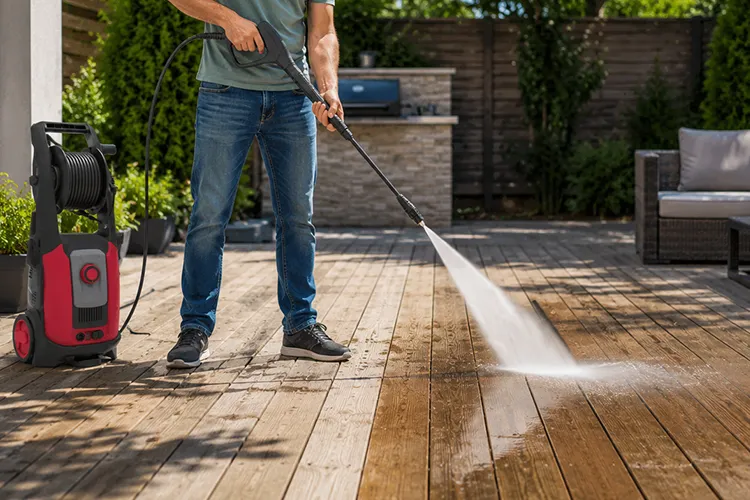
Characteristics: Wood is a flexible material with a much lower pressure resistance than concrete. Excessive pressure may cause wood fibers to break, surface burrs to increase, or the wood to absorb water and swell.
Recommended cleaning pressure:
| Timber Types | Recommended Pressure |
| Softwood | 500-800 PSI |
| Common Timber | 800-1200 PSI |
| Hardwood | 1000-1500 PSI |
Cleaning Steps:
1. Pre-rinse on low pressure mode
2. Spray with wood-specific cleaner and wait 5-10 minutes
3. Clean along the grain, avoiding lateral impacts
4. Air dry naturally. If necessary, reapply waterproofing or wood wax protection.
Different Road Surface Pressure Selection
| Road Surface Types | Recommended Pressure Range | Suitable Nozzles |
| Concrete | 1500-3000 PSI | 15°/25° |
| Asphalt | 1000-2000 PSI | 25°/40° |
| Brick road | 1000-1800 PSI | 25°/40° |
| Natural stone | 800-1800 PSI | 40° |
| Wooden flooring | 500-1200 PSI | 40° |
Common Stain Types and Treatment Methods
1. Dust
• Causes: Airborne particulate matter, vehicle dust, construction dust
• Treatment: 1000-1500 PSI, fan-shaped nozzle rinsing
2. Mud
Causes: Roads after rain, yard entrances
Difficulty: Forms a hard crust after drying, adhering to surfaces
Treatment: Soak to soften beforehand, rinse with 1500-2500 PSI
3. Moss & Algae
Common Locations: Shady areas, brick roads, stone, north-facing walls
Difficulty: Strong biological adhesion, root system, difficult to eradicate with water pressure alone
Treatment: Spray algaecide → wait 10-20 minutes → rinse with 1500-2000 PSI → treat with anti-algae treatment if necessary
4. Tire Marks
Common Locations: Garage entrances, parking spaces, concrete surfaces
Causes: Tire rubber adheres to the ground due to friction and heat.
Treatment Method: Use degreaser → Wait 15 minutes → Rotate the nozzle to clean, pressure 2000-3000 PSI
5. Oil Stains
Difficulty: The microporous structure of concrete allows grease to penetrate deeply, classifying it as a ★★★★★ level stubborn stain.
Treatment Method:
- Use cat litter or oil-absorbing powder to absorb the surface oil layer.
- Spray with concrete degreaser, wait 15-30 minutes.
- High-pressure wash at 2500-3000 PSI, moving from the outside to the center. Deep oil stains require 2-3 repeated treatments.
Specialized treatment solutions for stubborn stains
| Types of Stains | Common Locations | Cleaning Difficulty | Recommended Treatment Methods |
| Engine oil stains | Garages, parking lots | ★★★★★ | Degreaser + High-pressure flush |
| Tire marks | Concrete roads | ★★★★ | Degreaser + Rotary nozzle |
| Moss and algae | Brick roads, stone roads | ★★★★ | Algaecide + Low-pressure flush |
| Rust | Industrial areas | ★★★★ | Rust remover + Low-pressure flush |
| Cement residue | Construction areas | ★★★★★ | Chemical softening + High-pressure cleaning |
| Old grime | Outdoor roads | ★★★★ | Immersion + High-pressure cleaning |
Rust removal method: Use rust remover → wait 5-15 minutes → rinse with low pressure at 1000-1500 PSI to avoid surface damage.
Cement residue removal method: First scrape off the thick layer with a scraper → soften with cement remover (weak acid) → final clean with 2000-3000 PSI.
1. Do not spray directly onto the human body – high-pressure water may cause skin or eye injury.
2. Avoid damaging surfaces – do not rinse the same spot for extended periods, and avoid using excessive pressure.
3. Electrical safety – prevent water from entering plugs, use leakage protection devices, and keep the power supply environment dry.
How to Choose a Suitable Electric High-Pressure Washer for Home Street Cleaning?
When choosing a home electric high-pressure washer, you should not only look at the maximum pressure value, but also consider the working pressure (PSI/Bar), water flow rate (GPM/LPM), motor type, pump structure, and nozzle configuration.
Recommended Pressure for Household Street Cleaning
| Application Scenarios | Recommended Pressure | Recommended Bar | Applicable Equipment |
| Car Washing | 1200-1800 PSI | 80-125 Bar | Home Small Washing Machine |
| Household Floors | 1500-2200 PSI | 100-150 Bar | Home Electric Washing Machine |
| Concrete Roads | 2000-3000 PSI | 140-200 Bar | High-Performance Electric Washing Machine |
| Light Commercial Cleaning | Above 2500 PSI | Above 170 Bar | Professional Grade Equipment |
Which is More Important, Pressure (PSI) or Flow Rate (GPM)?
Cleaning effectiveness depends not only on pressure but also on flow rate.
• Pressure determines the force with which it impacts stains.
• Flow rate determines the efficiency with which stains are removed.
Example: Comparing device A (3000 PSI, 1.2 GPM) and device B (2200 PSI, 2.0 GPM), for large-area road cleaning, device B may be more efficient because the larger water flow can quickly cover the area and remove more dirt.
Recommended Parameters for Home Street Cleaning
| Parameters | Recommended Range |
| Pressure | 1500-2500 PSI |
| Flow rate | 1.5-2.5 GPM |
| Power | 1500W-2500W |
| Motor | Series or induction motor |
| Hose length | 5-10 meters |
Standardized Cleaning Operation Procedure
1. Inspect Road Surface Material – Confirm road type and determine pressure and nozzle selection.
2. Clean Surface Debris – Remove stones, leaves, and sand to prevent nozzle clogging.
3. Select Appropriate Nozzle:
| Nozzle Colors | Angle | Main Uses |
| Red | 0° | High-impact cleaning, for stubborn stains in small areas |
| Yellow | 15° | Heavy cleaning |
| Green | 25° | Road and concrete cleaning |
| White | 40° | General cleaning |
| Black | Low pressure | Spraying cleaning agents |
4. Pre-treatment of stains—Oil, moss, mold, etc., require pre-treatment with a cleaning agent.
5. High-pressure rinsing—Maintain a distance of 30-50cm, move at a constant speed, and avoid stopping in one spot.
6. Secondary inspection—Confirm that there are no residual stains or surface damage; repeat cleaning if necessary.
Common Mistakes and How to Avoid Them
| Incorrect Practices | Correct Procedure |
| Using maximum pressure to clean all surfaces | Adjust pressure according to the material |
| Spray gun too close (<30cm) | Maintain a distance of 30-50cm |
| No pretreatment for stubborn stains | Use cleaning agent first, then high-pressure rinse |
| Ignoring nozzle selection | Select the appropriate nozzle angle according to different applications |
| Prolonged rinsing in one spot | Move the spray gun at a constant speed |
Common Problems Encountered during the Use of Home Electric Pressure Washers
Q1: What surfaces can a household electric pressure washer clean?
It can clean a variety of surfaces, including concrete roads, asphalt roads, brick roads, natural stone, wooden decks, patios, outdoor walls, fences, etc.
Q2: What pressure is needed to clean concrete roads?
2000-3000 PSI is recommended. Reduce pressure for light dust; higher pressure is needed for oil stains and stubborn contamination.
Q3: Can a pressure washer remove oil stains?
Yes, but for long-term oil stains, pre-treatment with a degreaser is necessary before high-pressure cleaning.
Q4: Will high-pressure cleaning damage asphalt roads?
Yes. Excessive pressure may damage the asphalt surface. A low-pressure setting of 1000-2000 PSI is recommended.
Q5: What nozzle is best for cleaning driveways?
A 25° nozzle is recommended, as it strikes a good balance between cleaning power and surface protection.
Choosing the right pressure is crucial for maximizing the cleaning effectiveness of your home electric pressure washer. Home electric pressure washers are efficient outdoor cleaning tools that can quickly handle patios, garage floors, concrete areas, brick roads, stone surfaces, and wooden decks. However, different surfaces require different cleaning solutions:
• Concrete: 2000-3000 PSI to remove dirt and oil.
• Asphalt: 1000-2000 PSI to protect the surface structure.
• Brick Roads: 1000-1800 PSI to avoid damaging grout.
• Stone: 800-1800 PSI to protect the natural grain.
• Wooden Floors: 500-1200 PSI to avoid damaging the wood fibers.
The correct cleaning method = appropriate pressure + correct nozzle + detergent pretreatment + standardized operating procedures. This not only improves cleaning efficiency but also extends the life of your roads and equipment.
Looking for A Reliable Electric Pressure Washer Supplier?
Whether you need to clean your driveway, yard, vehicles, garden paths, or outdoor surfaces, choosing a high-performance electric pressure washer will make cleaning faster and easier.
Kormeson electric pressure washers offer:
• High-efficiency cleaning performance
• Multiple nozzle configurations
• Durable motor system
• Easy home operation
Contact us today to find the right pressure washer solution for your market.