

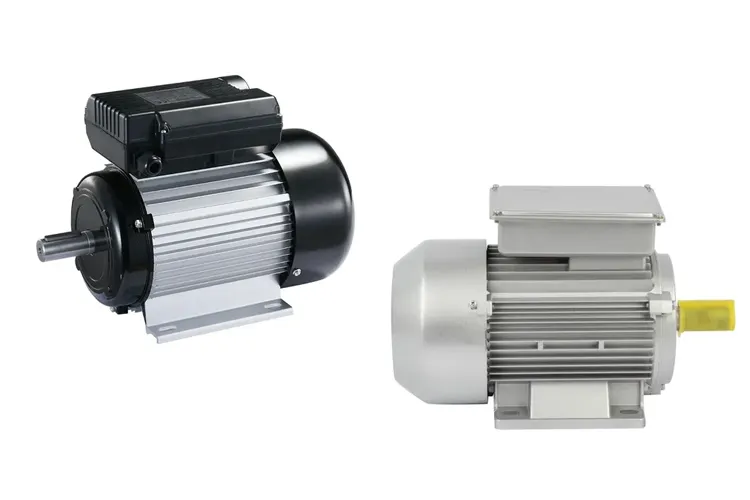
In electric high-pressure washers, the motor is the core component that determines the equipment’s performance, lifespan, and cleaning efficiency. Currently, electric high-pressure washers on the market mainly use two types of motors: Universal Motors and Induction Motors.
Among them, induction motors (also known as asynchronous motors) are widely used in mid-to-high-end electric high-pressure cleaning equipment due to their stable operation, low noise, long lifespan, and suitability for extended periods of operation, especially in heavy-duty household cleaning, commercial cleaning, and industrial applications.
What is an Induction Motor?
An induction motor, also known as an asynchronous motor, is an AC motor that operates based on the principle of electromagnetic induction. Its name “asynchronous” stems from a key characteristic: the actual rotational speed of the rotor is always slightly lower than the synchronous speed of the stator’s rotating magnetic field; there is a “slip” between the two. It is this “asynchronous” operation that allows the rotor conductors to continuously cut the magnetic field, inducing current and thus generating driving torque.
In the field of high-pressure washers, induction motors are generally divided into two main categories: single-phase induction motors (household 110V~220V) and three-phase induction motors (industrial 380V~420V). Single-phase induction motors mostly use a capacitor-start structure, while three-phase induction motors are widely used in large industrial cleaning equipment with power ranging from 5.5kW to 30kW. Based on rotor structure, they can be further divided into squirrel-cage and wound-rotor types, with the squirrel-cage type being the most common due to its simple structure and durability.
Working Principle: A Refined Demonstration of Electromagnetic Induction
The working principle of an induction motor can be summarized as “electromagnetic induction drive.” When AC power is applied, alternating current flows through the stator windings, generating a rotating magnetic field in the air gap. This rotating magnetic field acts like an “invisible magnet,” rotating synchronously in space. The rotor windings (usually squirrel-cage bars) are situated within this rotating magnetic field, and due to electromagnetic induction, induced electromotive force and induced current are generated in the rotor conductors. The current-carrying rotor conductors experience electromagnetic force in the rotating magnetic field, forming an electromagnetic torque that drives the rotor to rotate in the direction of the rotating magnetic field.
In simple terms: Power supply → Induction motor → High-pressure pump → Spray gun → High-pressure water flow. The induction motor does not directly generate pressure; instead, it drives the pump body through stable mechanical power, enabling the high-pressure washer to achieve continuous and efficient cleaning.
It is worth noting that the rotor can never “catch up” with the speed of the rotating magnetic field—if it did, the rotor conductors would no longer cut the magnetic lines of force, the induced current would disappear, and the torque would also disappear. It is this asynchronous state of “always just short” that constitutes the physical basis for the continuous operation of the induction motor.
Core Advantages of Induction Motors
1. Brushless Design, Extremely Long Lifespan
The core advantage of induction motors lies in their elimination of carbon brushes and commutators. Brushes, the first component to wear in series motors, typically have a lifespan of only 500 to 1000 hours; induction motors, lacking this vulnerable component, theoretically have a lifespan of tens of thousands of hours, more than four times that of series motors. For scenarios requiring frequent and long-term use, such as commercial car washes and factory workshops, induction motors significantly reduce maintenance costs associated with replacing motors or carbon brushes.
2. Extremely Low Operating Noise
Induction motors operate smoothly with significantly lower noise levels than series motors. Actual test data shows that high-pressure washers equipped with induction motors operate with noticeably less noise. For users in residential areas, underground garages, or quiet environments, the quiet experience offered by induction motors represents a qualitative leap. One user commented that induction motor washers offer “low noise, no disturbance to neighbors, and a peaceful cleaning experience.”
3. High Efficiency, Low Heat Generation
Induction motors typically have higher energy conversion efficiency than series motors, resulting in lower current consumption and less heat generation at the same power output. Some high-end commercial induction motor pumps achieve a total energy efficiency of up to 60%. Lower heat generation means slower aging of the motor’s internal insulation, further extending its service life.
4. Stable and Reliable Operation
Induction motors have a simple, robust, and durable structure. Without the sparking and electromagnetic interference problems associated with brush contacts, operation is smoother and more reliable. Many commercial models are also equipped with thermal protection functions, ensuring efficient and continuous operation even in frequent and intensive cleaning operations. Some products also integrate multiple safety mechanisms such as overload protection, leakage protection, and temperature rise protection.
5. Strong Aging Resistance
Induction motors use high-quality materials such as thickened silicon steel sheets, exhibiting significantly better aging resistance than series-wound motors. Performance degradation is slower over long-term use, maintaining stable pressure and flow output.
Inherent Disadvantages of Induction Motors
1. Greater Weight
The rotor structure of an induction motor results in a significantly larger size and weight compared to a series-wound motor of the same power. A high-pressure washer equipped with an induction motor is often several kilograms heavier than one with a series-wound motor, compromising portability.
2. Higher Price
Due to the more complex winding structure and the use of higher-quality copper and silicon steel sheets, the manufacturing cost of an induction motor is significantly higher than that of a series-wound motor. High-pressure washers equipped with induction motors are typically several hundred or even thousands of yuan more expensive than their counterparts with series-wound motors.
3. Relatively Lower Starting Torque
The starting torque of an induction motor is not as strong as that of a series-wound motor. In scenarios requiring instantaneous high-pressure build-up, the response speed of an induction motor is slightly slower. However, for most cleaning operations, this difference is not noticeable in actual use.
4. Certain Power Supply Requirements
Some high-power three-phase induction motors require industrial power supplies and cannot be used directly in household settings. While single-phase induction motors can use household power, they may experience starting difficulties in areas with unstable voltage.
As market demands for equipment durability and quiet operation continue to rise, induction motor technology is evolving in the high-pressure washer industry. On one hand, optimized motor design and the introduction of new materials further enhance durability and anti-interference capabilities. On the other hand, with the application of IoT technology, future induction motor high-pressure washers will place greater emphasis on intelligent management and preventative maintenance. The global market size for induction motor electric high-pressure washers is also showing a continuous growth trend.
With its core advantages such as brushless operation, ultra-long lifespan, extremely low noise, and high reliability, the induction motor has become the top choice for those seeking quality and durability in the high-pressure washer field. While it may compromise on price and weight, it is a worthwhile investment for commercial users and home users who prioritize long-term performance. If you are looking for a high-pressure washer that can last for many years, products equipped with induction motors are worth considering—they may not be the cheapest, but they are certainly the most worry-free.