

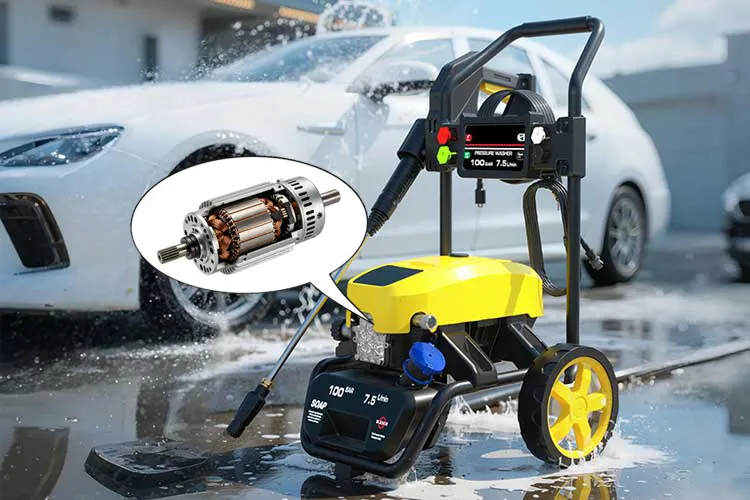
When choosing a pressure washer, many users tend to focus on PSI (pressure), GPM (flow rate), power, and nozzle type. While these parameters are important, the core component that truly determines the equipment’s performance, lifespan, and daily user experience is actually the motor.
Currently, electric pressure washers on the market primarily use two types of motors: universal motors and induction motors. Both types can drive a high-pressure pump to generate a powerful water flow, but they differ significantly in structure, performance, lifespan, noise, and applicable scenarios.
So the question arises: which is better, a universal motor or an induction motor?
The answer depends on your usage needs. If you only occasionally wash your car, rinse furniture, or clean small areas of the floor, a universal motor is perfectly adequate and offers better value for money; if you need to operate for extended periods and prioritize stable pressure and lower noise, an induction motor is undoubtedly the better choice.
Introduction to Series Motors and Induction Motors
A series-wound motor, technically a single-phase series-wound motor, gets its name from the series connection of its field winding and armature winding. The most significant characteristic of a series-wound motor is its AC/DC dual-use capability—it can be powered by either AC or DC power, hence its international reputation as a universal motor.
The core structure of a series-wound motor includes a stator, rotor, and carbon brushes. The stator consists of a salient-pole core and a field winding, while the rotor consists of a non-salient-pole core, armature winding, commutator, and shaft. The field winding and armature winding form a series circuit through the brushes and commutator.
Alternative names: Carbon brush motor, Universal motor
Key features: Carbon brushes, AC/DC dual-use, High speed
Common applications: Portable household cleaning machines, Lithium-ion battery cleaning machines
An induction motor, also known as an asynchronous motor, is an AC motor that operates based on the principle of electromagnetic induction. Its name “asynchronous” stems from a key characteristic: the actual speed of the rotor is always slightly lower than the synchronous speed of the stator’s rotating magnetic field, resulting in a “slip.” This asynchronous operation allows the rotor conductors to continuously cut the magnetic field, inducing current and generating driving torque.
The core advantage of induction motors lies in their brushless structure—eliminating the need for carbon brushes and commutators, resulting in a simple, robust, and durable design.
Alternative names: Brushless motor (broadly defined), Asynchronous motor
Core features: Brushless, extremely long lifespan, low noise
Commonly found in: Commercial and industrial high-pressure washers
Series-wound motors are “sprinters” seeking cost-effectiveness—fast start-up, high speed, and affordable price.
Induction motors are “marathon champions” prioritizing durability—long lifespan, low noise, and stable operation.
Comprehensive Comparison Across Six Dimensions
| Comparison Dimensions | Series-wound motor | Induction motor |
| Motor Type | Series-wound motor (brushed) | Asynchronous motor (brushless) |
| Whether Carbon Brushes are Present | ✅ | ❌ |
| Power Supply Type | AC/DC dual-use | AC dedicated |
Series motors achieve current commutation through carbon brushes and a commutator; however, the carbon brushes are wear-prone components and will continuously wear down. Induction motors, on the other hand, rely on the principle of electromagnetic induction to drive the rotor, with no mechanical contact parts, thus fundamentally eliminating the source of wear.
Performance Parameter Comparison
| Comparison Dimensions: | Series-wound motor | Induction Motor |
| Speed Rotation | High speed (up to 10,000-30,000 rpm and above) | Lower speed (approx. 1400-3000 rpm) |
| Starting Torque | Powerful (3-5 times the rated speed) | Generally |
| Efficiency | Approximately 65-85% efficiency | Approx. 70-95% |
| Speed Regulation Method | Adjust voltage | Requires complex equipment such as frequency converters |
Tips: Series motors have a much higher speed than induction motors, giving them an advantage in pressure and flow rate at the same power. However, induction motors are more efficient and run more smoothly.
Lifespan Comparison
Series Wound Motor: Carbon brushes are the core weakness. Carbon brush lifespan varies depending on the operating environment and brush quality, generally between 800 and 1000 hours. Poor-quality carbon brushes may wear out in just tens of hours. Carbon dust accumulation after prolonged operation can also lead to decreased motor insulation.
Induction Motor: No carbon brush wear; theoretical lifespan can reach tens of thousands of hours. Commercial-grade induction motors have undergone 500 hours of operation testing, and their pressure switch lifespan can reach 50,000 cycles.
Tips: The lifespan of an induction motor is several times, even tens of times, that of a series wound motor.
Noise Level Comparison
Series Wound Motor: Loud noise is the most common complaint from users – “Series wound motors are quite noisy.” The noise level of a series wound motor and pump during normal operation is generally 80-90 decibels.
Induction Motor: Low noise, known as a “silent motor.” High-quality induction motors can reduce noise to 70.9 decibels. One user commented: “25 decibels less than a series wound motor…even the sound of a water gun spraying water is louder than the motor; people nearby can still have normal conversations.”
Tips: Induction motors are about 10-20 decibels quieter than series wound motors, making a very noticeable difference in user experience.
Series motor VS Induction motor: A Comprehensive Comparison
While both series motors and induction motors can drive high-pressure washers, their design goals are quite different. Series motors prioritize low cost, lightweight design, and portability; induction motors, on the other hand, focus on stable output, long-term operation, and industrial-grade reliability.
| Comparison Items | Series-wound motor | Induction Motor |
| Motor Structure | With carbon brushes and commutator | Brushless, simpler structure |
| Size | Smaller | Larger |
| Weight | Lighter | Heavier |
| Purchase Cost | Lower | Higher (approx. 3 times) |
| Operating Noise | Higher (85-100dB) | Lower (approx. 70-75dB) |
| Lifespan | Shorter (carbon brush life approximately 200-1000 hours) | Longer (tens of thousands of hours) |
| Maintenance Requirements | Requires regular carbon brush inspection | Very maintenance-free |
| Continuous Operation Capability | General | Excellent |
| Output Stability | Ordinary | More stable |
| Heat Dissipation Capacity | Weaker | Better |
| Suitable Pressure Range | 1500-3000 PSI | 2500-5000 PSI |
| Main Applications | Household cleaning | Commercial and industrial cleaning |
Cleaning Performance Comparison: Which Motor Offers More Stable Pressure?
Many users believe that “the higher the pressure, the better the cleaning effect.” In reality, the cleaning ability of a high-pressure washer is determined by multiple factors: PSI (water pressure), GPM (water flow rate), motor output stability, pump quality, and nozzle design. The motor’s role is to continuously provide power to the pump.
Series-Wound Motor Cleaning Performance
Series-wound motors are typically used in household high-pressure washers with pressure ratings of 1500-3000 PSI, suitable for car washing, motorcycle washing, outdoor furniture cleaning, and small-area floor cleaning.
Advantages: Quick start-up, affordable price, and easy to use.
Disadvantages: During prolonged continuous operation, issues such as motor temperature rise, output decrease, and pressure fluctuations may occur.
Induction Motor Cleaning Performance
Induction motors are typically used in high-performance equipment with pressure ratings of 2500-5000 PSI or even higher, suitable for cleaning building exteriors, garage floors, commercial vehicles, and factory equipment.
Advantages: Continuous power output, more stable water pressure, and support for higher flow rates.
Disadvantages: Lower starting water pressure, higher price, and larger size.
How to Choose the Right Washer for Different Scenarios?
Home Car Wash
Recommendation: Series motor high-pressure washer
Reasons: Low usage frequency, small cleaning area, more affordable.
Suggested Parameters: 1500-3000 PSI, 1400W-1800W.
SUV and Pickup Truck Wash
Recommendation: Series motor or induction motor
Reasons: Larger vehicles have more dirt, larger surface area, and longer cleaning time.
Suggested Parameters: 2000 PSI and above.
House and Patio Cleaning
Recommendation: Series motor or induction motor
Suitable for: Concrete, brick walls, paving stones, fences, etc.
Reasons: Requires stable pressure and continuous operation for extended periods.
Commercial Car Wash and Industrial Cleaning
Recommendation: Induction motor
Reasons: Commercial environments require daily operation, high reliability, and low maintenance costs.
Frequently Asked Questions (FAQ)
Q1: Are induction motors better than series motors?
Induction motors generally have a longer lifespan, lower noise, and better continuous operation capability. However, series motors are more advantageous in terms of price and portability, making them suitable for light home users.
Q2: Can a series motor high-pressure washer meet daily needs?
Absolutely. For light home cleaning, series motors offer excellent value for money.
Q3: Why are induction motor high-pressure washers more expensive?
Because induction motors have a more complex structure, higher material costs, and a longer lifespan.
Q4: Can a series motor clean concrete?
Yes, but it is recommended to choose a higher pressure model and avoid prolonged continuous operation.
Q5: Which motor should be chosen for commercial cleaning?
Induction motors. The reasons are stable operation, less maintenance, and a longer lifespan.
For those needing low-cost, lightweight equipment and occasional cleaning, series-wound motor high-pressure washers are a good choice.
For those requiring high pressure, long-term operation, longer lifespan, and commercial applications, induction motor high-pressure washers are more suitable.